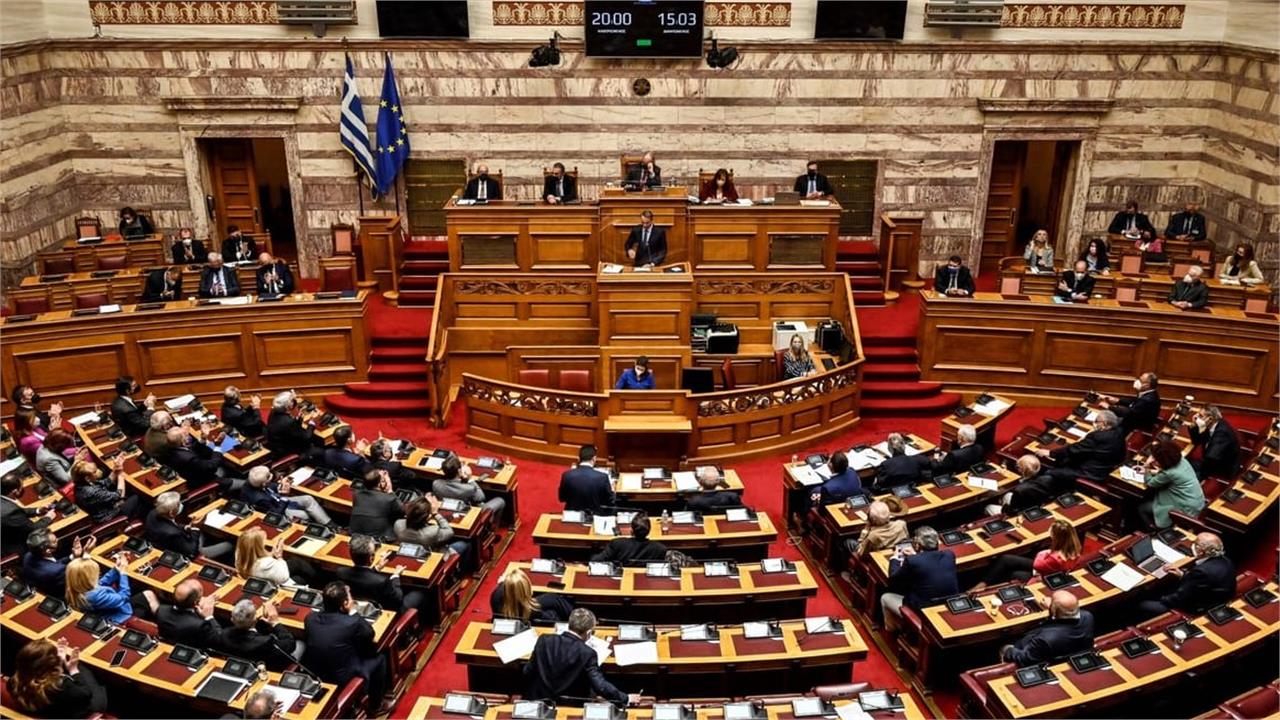
On March 10 the Chairman of the Institute, Costis Stambolis, upon the invitation of the preparatory committee in charge of clearing the draft law on new hydrocarbon concessions, and submit it for final hearing and voting through the Greek Parliament, testified in an open session along with party speakers and representatives from civil society organisations. The bill in question, which was eventually voted through Parliament on March 13 ratified the concession agreements which the Greek Government had signed earlier, on February 16, with a consortium of companies comprising US ‘s Chevron and Helleniq Energy for four offshore blocks south of Peloponnesos and South of Crete.
The agreements grant right for exploration and potential production of oil and gas in maritime blocks south of Crete and the Peloponnese. MP’s from the ruling New Democracy aperture and the main opposition PASOK opted in favour of the bill. Deputies from lesser opposition parties, on both the left and right of the spectrum,voted against while the “Geek Solution” party declared “present”. Closing the two- day debte, Energy and Environment Minister Stavros Papastavrou described the agreement with the above consortium as a “historic moment”, calling it a “leap forward for the utilisation of the country’s energy wealth” and “fundamental choice for a Greece that is outward-looking,energy resilient and energy self-sufficient”.
In his deposition during the preliminary hearings the Chairman of IENE supported in principle the bill since,as he explained, it will help Greece to utilise its considerable,but yet unproven, hydrocarbon potential. He further noted that supporting hydrocarbon exploration work in offshore Greece is in line in meeting the country’s energy needs as oil and gas ( which is 100% imported at great cost) will continue to be used worldwide for many -many years ahead and therefore it is to the country’s advantage to develop its own indigenous energy resources. Costis Stambolis then quoted international statistics indicting a continuous rise of oil production and supply for both oil and gas. Furthermore he observed that In spite of efforts and huge investments over the last 50 years global primary energy production is 86,6% dependent on fossil fuels. A situation which is not likely to change much over the next 20 years at least, in view of continuously rising energy demand, primarily from emerging economies.
The only observation on the actual bill by IENE’s Chairman was on the need to introduce an article or amend an existing one, in order to safeguard the time framework of the concession agreement with respect to carrying out the first exploratory drilling. He suggested that the time foreseen should be clearly stated in the bill and should be a maximum of 3 years which he reckoned provides the companies with adequate time to assess the area under exploration and decide whether it is worth drilling. Following that, the consortium should either carry out a drilling operation or return the rights of the block to the state, as is early foreseen by the existing law.