On March 9 the Paris based OECD, in cooperation with the Delphi Economic Forum, convened a special meeting in Greece’s northern capital Thessaloniki in order to launch their latest project, on “Electricity, Digital and Regional Interconnectivity in South East Europe”. It is anticipated that this project will foster cooperation in the energy sector and most importantly will provide policy recommendations to enhance electricity interconnections between the Western Balkan economies, Greece and other EU countries.
The Issue
Over the past two decades, the Western Balkan six economies (WB6) have undergone a comprehensive economic and political transformation moving closer to the Single Market and the European Union (EU). However, further effort is required, so that both regional GDP per capita may increase (from the 39.4% of the EU average in 2023) and more progress is achieved across several other key indicators and policy areas.
The energy market is one such area. For instance, energy productivity remained at around 80% of EU levels for the period 2020-23. In addition to this, recent OECD analysis shows that power losses continue to be a challenge for accessing reliable and affordable energy supply (source: Economic Convergence Scoreboard for the Western Balkans 2025).
Energy is seen by OECD as indispensable for economic activity and a key pillar of competitiveness. The WB6 can achieve substantial economic, social and environmental benefits by ensuring that their energy sectors are competitive, well-governed and sustainable. Cross-border energy connectivity is a priority and remains underdeveloped, limiting the economies' integration into regional energy markets, reducing access to enhanced energy security and limiting resilience to external shocks.
Recent OECD analysis shows that the Western Balkan economies have yet to improve their frameworks in order to establish a truly competitive energy market and foster further sustainable economic growth in the long run. This analysis assesses the existence, independence and effectiveness of regulatory authorities in each WB6 economy, as they are key actors of competitive energy markets. (source: Western Balkans Competitiveness Data Hub 2024).
The Project
The OECD project Electricity, Digital and Regional Interconnectivity in South East Europe will help Western Balkan economies, focusing on Albania, Kosovo*, North Macedonia and Serbia, address systemic connectivity challenges and regulatory gaps in the energy sector, strengthening the region’s ability to navigate the complexities of modern energy networks.
The project aims at strengthening the strategic framework for energy infrastructure and markets – particularly in the electricity sector. It will examine how deeper cross-border energy interconnection and more integrated modern digital technologies can improve energy efficiency, resilience and security, grid connectivity, and the transition to sustainable energy models.
The project combines analytical and capacity-building work. A report will provide analytical insights into the electricity and energy connectivity, infrastructure and markets in the Western Balkans, focusing on the Western Balkans interconnectivity potential with EU Member States in the region. Through strategic engagement workshops and regional policy dialogues, the project will reinforce institutional capacities to improve the overall policy, legal and institutional frameworks governing the energy sector in the WB6 economies.
The project is implemented by the OECD South East Europe Regional Programme and runs from October 2025 until September 2027.
The Colloquium
This one day meeting was conducted at Ministerial and Expert level with the Deputy Minister for Energy of Greece Mr.Nikos Tsafos participating along with the Minister of Energy,Mining and Mineral Resources of North Macedonia,Sanja Bozinovska, the Consul General of Romania in Thessaloniki, Corina Crete and the Senior Advisor to the Minister of Mining and Energy of Serbia,Aleksandar Zlatkovic. With George Pagoulatos, Ambassador of Greece to the OECD moderating the Ministerial panel. Present from the OECD were Karim Dahou, Deputy Director of the OECD Global Relations and cooperation Directorate, and Gabriela Miranda, Senior Advisor, SEE Regional Programme, who is the Project Coordinator.
In the next panel which examined “Investment, Finance and Governance for Energy Connectivity in South East Europe”, with moderator George Plevris, Head of Strategic Planning & Int’l Cooperation, Ministry of Environment & Energy, the following participated:
Marianna Nathanail, Head of EIB Group Office in Greece, European Investment Bank (EIB)
Maja Turkovic, Executive Vice President, CWP Europe
Theresa Reichstadt, Research Leader of Energy and Environment, RAND Europe
Volker Raffel, CEO, E.ON, Romania
IENE Participation
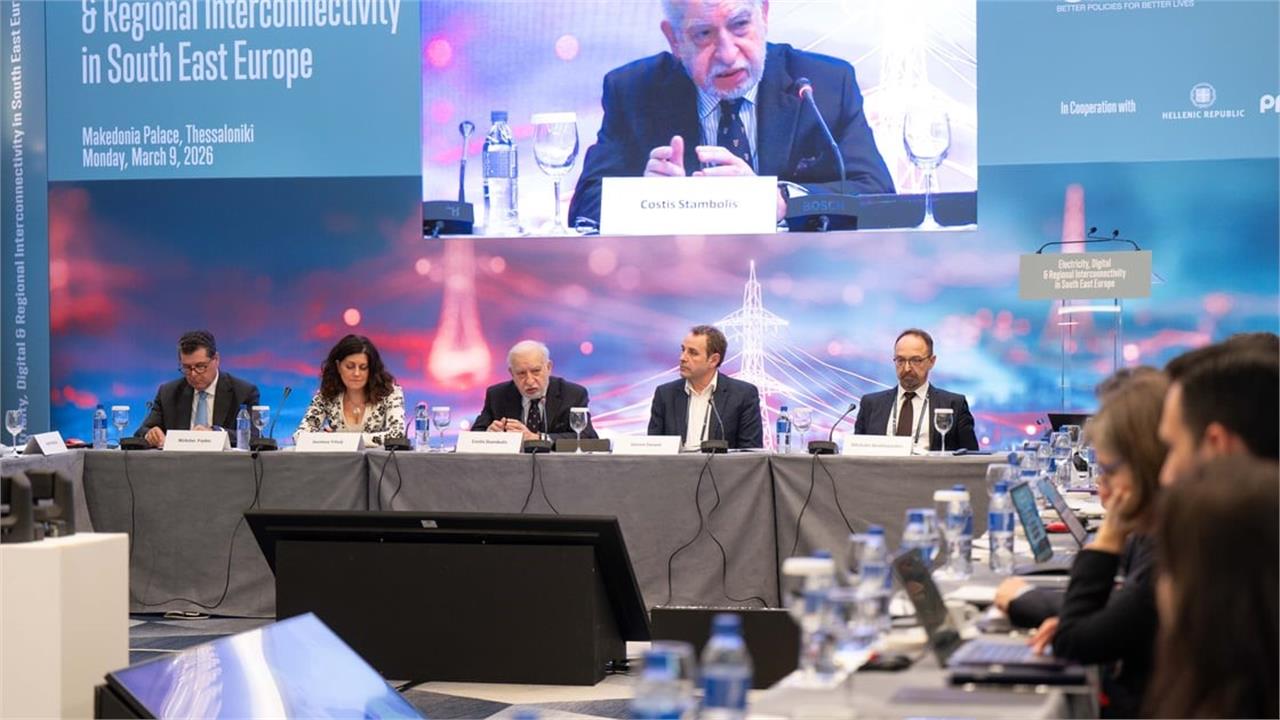
The last session of the Colloquium covered issues related to “Unlocking Opportunities for Regional Integration: Upgrading Energy Infrastructure and Building Resilience” and was moderated by Costis Stambolis, Chairman and Executive Director of IENE.
This panel explored how upgraded energy infrastructure, enhanced interconnectors, and modernised grid systems can unlock new opportunities for deeper regional integration and greater energy resilience in the Western Balkans. Panelists examined how digitalisation can improve system flexibility and efficiency, alongside emerging approaches for integrating renewables and storage into long-term infrastructure planning. The discussion also highlighted the policy frameworks and governance tools that can support resilient, interoperable networks capable of accommodating cross-border electricity flows and accelerating the region’s alignment with European market standards.
Participants in the panel included: Gezim Tosuni, Chair of the Board of Directors, Kosovo Transmission System Operator – KOSTT , Michalis Mathioulakis, Academic Director, Greek Energy Forum, Jasmina Trhulj, Head of Electricity Unit, Energy Community Secretariat, Austria, Nickolas Frydas, Director Regulatory Innovation & Strategy, IPTO S.A.